Aluminium windows in Ashtead: detached houses from the inter-war boom, and the three conservation areas
Ashtead is in Mole Valley, not Epsom and Ewell, so planning questions go to Mole Valley District Council. For most houses in the village the answer is simple, because the conservation areas are small.
How Ashtead was built
House building began around 1850 and picked up after the railway arrived in 1859. Much of the Howard family's estate was broken up and sold from the late 1870s, and the last of Ashtead Park was split up after 1924. The biggest building boom came between the wars, peaking in the 1930s, and the line through Ashtead was electrified in 1925, which made the village easier to commute from. Since then the Green Belt has kept new building inside the existing boundary, mostly as small groups of larger houses on former garden land.
The result is a village with a wide mix of house sizes, including many detached houses from the 1920s and 1930s and bungalows that have since been extended. Lower Ashtead, the residential area north-west of the station, has its own shops on Craddocks Parade and Barnett Wood Lane.
The conservation areas
Mole Valley designated three conservation areas in Ashtead in 1988: a group of ten buildings where Rectory Lane meets Dene Road, the area around Ashtead House east of the village, and a row of 14 Georgian houses on the west side of Woodfield Lane. Mole Valley's Article 4 directions cover parts of Dorking, Brockham and Leatherhead, not Ashtead. A house inside one of these areas still needs care with the front windows, and listed houses need listed building consent.
What suits Ashtead houses
On a 1930s detached house, slimline aluminium casements bring back the thin frames of the original windows, and a dark grey or black finish sits well against brick, render or tile hanging. Steel-look aluminium works on the Arts and Crafts houses. Extended bungalows often have a mix of window sizes from different decades, and changing them all at once in one frame type pulls the house together.
Ashtead Common and Ashtead Park are woodland and parkland, and houses that back onto them see a lot of leaf fall and damp. Aluminium needs only washing, which is easier than repainting timber in shade.
A typical job in Ashtead
Illustrative example of a typical job
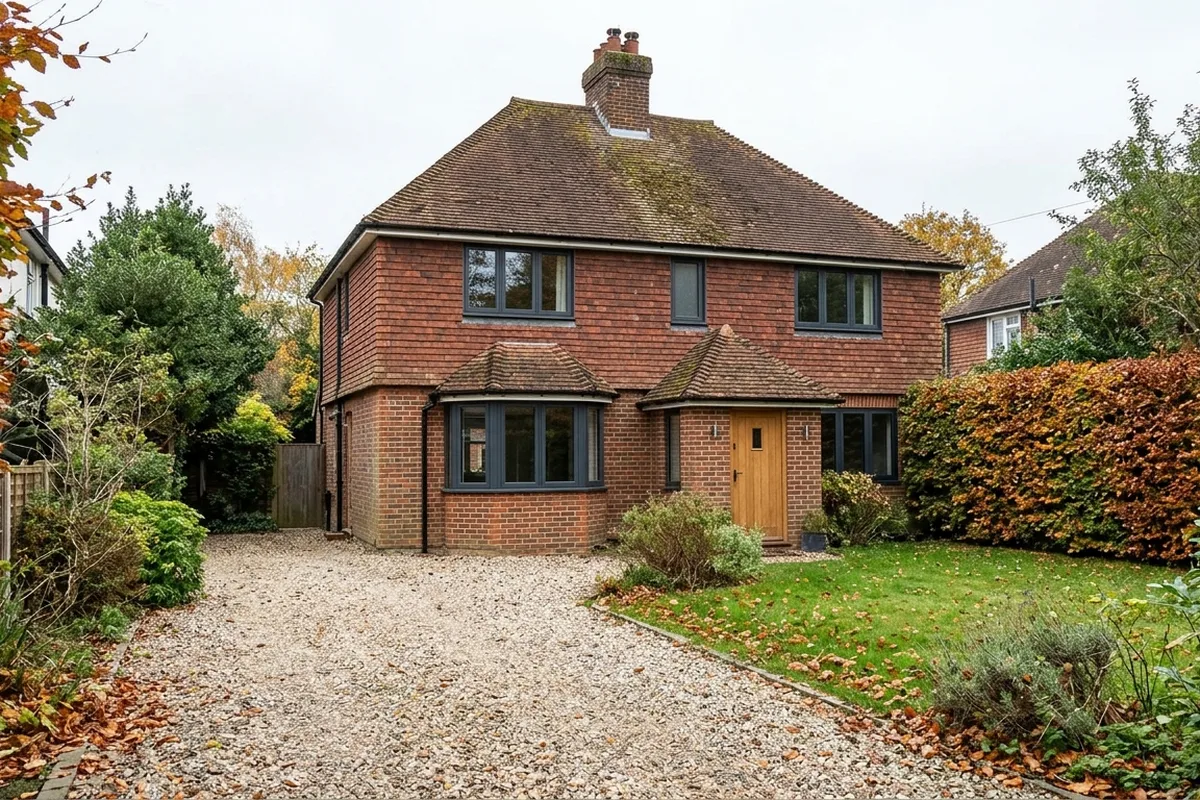
Whole-house slimline aluminium on a 1930s detached house in Ashtead
A detached 1930s house from Ashtead's inter-war building boom, with a two-window-wide front, a ground-floor bay and eight other casement windows.
Eight slimline aluminium casements, about 1200 mm by 1200 mm, priced as a whole-house order
One three-unit slimline aluminium canted bay
Dark grey outside and white inside, double glazed
Typically £15,350 to £28,150, supplied and fitted, including VAT